Showing posts with label toys and games. Show all posts

Monday, June 11, 2012

Contract Bridge

It was during this early period that I became acquainted with the game of bridge — by kibitzing the games that invariably went on during the noon hour. During my basic data days the bridge foursome included Charlie Hurd and one John Valentine, the other two being variable. In the fractionation group Sarno and Shiras always played, Jarman often with a fourth member a fill-in. This game continued after the move to Emeryville and then the fourth was one Kunstman, a younger engineer.

Following the conclusion of the actual playing there was often an extensive rehash of the hands that had been played. Shiras would defend his playing, which was often queer and erratic, and I recall that Kunstman was almost lived in his assessment of Shiras’ playing. I’ve often wondered how much of Shell’s time was absorbed and wasted in these post-game discussions.

When I started kibitzing was when honor count was the way used to evaluate a hand — it was only later that Goren’s point came into favor. But it was through watching these noontime games that my knowledge of the game developed and my liking of it as a card game.

After Jean and I were married I participated occasionally in the Shell tournaments sponsored by the Shell Development Recreational association. I recall playing in these with Jean as a partner, and also with Dwight Johnston. The latter was actually in a tournament outside of Shell and we actually garnered a few master-points. I believe I have them tucked away somewhere as a memento of the evening. I’m sure that they will not be joined by any further master-points.

Although I like to play bridge it is just that — “play” and not the serious business that really avid players make of it. For one thing, although I have a fair idea of the conventions as to bidding, I lack the fine points and do not have the experience to cope with unusual situations or to make lead-indicating signals in the bidding process. My technique on the play of a hand, either as a declarer or defensively, is even more fragmentary and my ability to keep a count as to what has been played in the course of the play of a hand is quite limited. Thus a substantial fraction of the time I bid and play is sort of by intuition.

All of this is in part I think, the result of the kind of bridge I was trained in initially — the Shell noontime contests. The level of bidding and play there were pretty much on the level of my bridge-playing skills. Always present at the Shell games was a considerable level of psychological play (almost as in poker) and this was the result of the players involved and the relationships between them. There was also the factor that the payers were acquainted with the type of play characteristics of the other players so that in certain situations the play was dictated not so much by the rules of the game but by the knowledge of what the players would do in certain situations. Typically there was as much glee expressed when an opponent succumbed to a psychological ploy as when the technically correct play was done. All of this rubbed off on me so that my type of play is suitable for friendly non-competitive situations but not where the level of play is serious.

In Ashland Jean and I used to play once a week or so with a couple from church who lived nearby. Their level of play (particularly of the husband) was similar to Jean’s and mine; the lady’s was somewhat erratic. These were pleasant social evenings but they were discontinued when Jean developed difficulty with going to sleep after them. Since then we tended to keep our evenings quiet and peaceful. Even the kind of social contact involved with an evening of bridge and table conversation was to be avoided if Jean was to be able to get to sleep easily afterward.

For awhile I also played duplicate bridge with an Ashland acquaintance, Colver Anderson. This was in a league that had a regular Friday session of play at Ashland’s recreation department hall. It was congenial enough and we continued to participate until a hand occurred in which an opponent objected to my bidding as not following bid conventions. It was a hand of somewhat unusual character so I had had to compromise in what I bid. The opponent called the tournament director over to review the situation. No action was taken but the whole episode left a very bad impression on men and I told Colver that I was not interested in continuing. Since then I don’t think I have played bridge at all.

Saturday, January 7, 2012

Jacks, Lunches, and a Close Call

I have strayed considerable from my review of recess activities (induced by my thinking of the mumble-ti-peg game and its association in my mind with Bible school). But back to recess.

Jacks was a girls’ activity but I remember playing the game with my sisters. During the winter months recess would be held in the gymnasium. This would also be where the children who brought their lunches with them (principally the rural children) would play during the noon hour after having eaten their lunches.

Lunches were eaten in a large room across the hall from the gymnasium. Once in a great while when we were still in the little brown house if the weather was inclement we would take our lunch to school. I remember once when Clarice and I, thinking that the day was going to be cold and snowy, badgered my mother into providing us with lunches to take to school. As it turned out the weather changed and the day became sunny and bright. We carried our lunches that day in some small tin pails, probably the containers for some corn syrup that my mother had bought.

Normally the only fare the children had for lunch was what they brought with them. But there was a period in which some hot dish was prepared and served. This may have been a project carried out by the home ec classes and it may have entailed a small cost to the students. The program may also have been a victim of Depression economics.

At this point I want to write about an event that occurred when Clarice and I were small children. I think both of us were involved directly although it may have been only Clarice. I have no personal recollection of the event, my information is all secondhand, and even then it may be faulty, as when I am not sure that it only concerned Clarice or the two of us.

One morning as we, or only Clarice was walking to school, the day was rainy with thunder and lightning, such as the Midwest can generate on occasion. For some reason Molly Rosene called to Clarice (or to us) to come back to her back porch to wait out the storm for a short time. During this interruption in the walk to school, lightning struck one of the two large cottonwood trees in front of the next house. The strike tore off part of the tree and sent it flying across the sidewalk and against the house where it broke a large glass window.

Had not Molly delayed Clarice (us) she (we) would have been in the vicinity of the tree when it was struck. What would have happened to Clarice (us) could have been quite serious I suppose.

Tuesday, January 3, 2012

Marbles and Mumble-ti-peg

Recess, when out-of-doors, was also characterized by such activities as playing marbles or mumble-ti-peg for the boys and playing jacks for the girls — although I suppose the latter could just as well be played indoors.

Jacks was not a boys’ game, although I remember playing the game with my sisters.

Playing marbles was an activity that came and went. There would be a spate of involvement, then it would die away for awhile. The marbles consisted of a shooter, which might be an agate, i.e. a stone carved to a spherical share and given a high gloss, or it might be a “glassie” which was the second-class marble. These came in different sizes, colors and design configurations. Then there were the lowly “commies” which were clay spheres with surfaces somewhat irregular. An agate might cost as much as 25 cents at the local drug store, which I seem to recall as the source of marbles locally.

There were two configurations of the game layout. The first was a single ring perhaps 15–18 inches in diameter within which each played placed an agreed-on number of marbles. To begin the game the players would stand some distance away from the ring for the “lagging” which consisted of the players tossing their shooter marbles toward the ring. The player whose marble was closest to the ring got to “shoot” first, with the rest in order of increasing distance from the ring.

The object of the game, was to propel the shooter marble by a hand/finger motion and cause it to hit one of the marbles in the ring. The hand/finger motion is a little hard to describe in words. The marble was held between the thumb above the top knuckle and the forefinger. The marble would be propelled forward by a sudden straightening of the thumb. If a player who was shooting knocked a marble out of the ring, he could continue until he failed to do so, when the next player in order would take his turn.

The game could be played for “keeps” in which the played kept all the marbles he shot out of the ring or I believe there was an alternative in which each player retained his own marbles (though I don’t recall the details of how this was handled, and it was not the usual alternative). More than two players could play, but two was most common and the number of players usually did not exceed three or four.

The other configuration of the game had two rings — a small central ring in which the marbles were placed and a concentric larger ring maybe three or four feet in diameter. There was also a straight line for the “lagging” part of the game.

The player lagging his shooter closest to this line started the next part of the game, with the other players in order. I don’t recall for sure in either configuration from what position the player made his first shot, or his subsequent ones.

In the second configuration I’m fairly sure that the first shot was made from the outer ring, at a position on the ring selected by the player. As in the other alternative, playing for “keeps” was the most common alternative. Glass marbles were the kind mostly used, but I recall one episode in which two of the better and more avid players played a game for keeps with agates. In addition to the school yard, a popular place for play was on a sandy area adjacent to the street along the west side of the city park. This would be the scene of games as boys went home for lunch, or returned before school began.

Mumble-ti-peg was played with a pen knife and the object of the game was to complete a series of maneuvers with the knife, each maneuver being successfully accomplished if the knife blade entered the ground so that the knife was more or less erect, when the knife was flipped in a certain way. I think the criterion if the knife was erect as it entered the ground was if two fingers could be placed superimposed on each other between the end of the knife and the ground.

Which player started first I don’t remember or how many players there usually were. A player completing one maneuver could continue on to the next until he failed to complete one successfully. Then the next player in order would take his turn. The player finishing first had the reward of shaping a small pointed stake which he would drive into the ground with three hits of the knife handle (the knife being held by the end of the blade). The loser then had to pull the stake out of the ground with his teeth.

Needless to say the game was usually played on a grassy area where the soil was reasonably moist so that the knife blade could fairly easily enter and stick in the soil.

I don’t remember this game much from public school — my recollections are mostly from vacation Bible school The name of the game doubtless came from the act of pulling the little stake out of the ground with the teeth.

Sunday, November 20, 2011

Erector Sets and Electric Trains

While I was a young boy I was attracted to such toys as Erector sets and electric trains. I was given an Erector set, perhaps as a Christmas present, but it was one of the smaller or intermediate sets. The larger set which I craved came with a small electric motor for activating the steam shovel or other item that had been made from the parts of the set. This desire on my part was never fulfilled.

I recall that one of the boys of my age had such a set and on one occasion I saw what he had made with it and was enthralled. Although I envied him his Erector set I surely didn’t envy him his later boyhood experience. His father was a rural mail carrier, a good stable job back at the time, and had in addition the income from some farm property — probably an inheritance. The father started to speculate on the Fort Dodge Board of Trade, lost the farm and the family home, and committed suicide.

My friend, his mother and sister had to move in with his mother’s parents as a place to live. His grandfather was Jonas Lindquist who had operated a clothing store in Gowrie for a long time — at the time of Clare’s father’s suicide he may have retired from the business.

I sort of lost touch with Clare in later years — he was retained a grade at school so he was no longer in my class and after our move to the farm I had limited contact with the boys I had played with in Gowrie.

Clare died quite some time ago. He died at a relatively early age. I think his sister still lives in the Twin Cities — she was Vivian’s grade and I think Vivian always liked and admired her.

As to electric trains my interest was aroused by the set Lennarson and Johnson (one of the two hardware stores in Gowrie in my youth) always set up in their window at Christmas. It appeared year after year, perhaps it was not for sale or was too expensive for the Gowrie clientele. It was a Lionel train, green as I recall.

During this time I had a subscription to American Boy magazine, and in this magazine there would be advertisements for both the Lionel and American Flyer electric trains. These usually offered a free booklet describing the various train sets and other items they had for sale and I sent for the booklets and dreamed of the trains shown. There was one train set for $13 and I calculated that if I were to save my weekly allowance for a full year I would have enough saved to purchase it — of course this never materialized.


I guess if I had saved the little booklets they might now be worth as much as some of the trains described in them. I seem to recall having read about these being real collector’s items.

Sunday, January 23, 2011

My Bicycle

I was the only one of us six children to get a bicycle and that happened because I was given $25 at the time I was born by my uncle Carl. I am quite certain that the reason behind my uncle’s gift was that I was born on his birthday and was naturally given his name.

When I was at the age where I craved a bicycle I was told by my parents that I could use this money for this purpose. Which I did, buying the bicycle from the Lennarson and Johnson hardware store. It received considerable use, both in such activities as following Harris on his paper route and later when we were living on the Peterson farm as a mode of transportation to Gowrie for such things as the Saturday morning Confirmation class. That lasted during the year when I was a freshman in high school. As I grew older and my use of it diminished, my brothers tool over, but they never used it to the extent I had.

I never felt much empathy with my uncle Carl, somehow or other our personalities did not respond to each other. I think my uncle had a more congenial relationship with my cousin Eugene. Perhaps this was because Eugene had lived on the Peterson farm as a child when my uncle Serenus was participating in the running of the farm. My uncle Carl would have tended to have had a closer contact with him on a more or less daily basis during Eugene’s early years. It is true that my uncle compensated me for the work I did for him and the farm and this helped me with my educational expenses at SUI. On the other hand he never helped me with my actual school expenses as he did with Eugene.

Saturday, December 11, 2010

Paper Dolls

Writing about paper dolls reminds that this was a childhood play activity in the Strand household. Clarice, Vivian and I participated actively — I don’t really remember if my three younger brothers did. The source of the paper dolls was not magazines such as Nellie Scott subscribed to but rather outdated editions of mail order catalogs — Sears, Montgomery Ward, and Bellas Hess. We would cut out not only the appropriate dolls in various dress, but also appurtenances such as furniture, toys etc. What we did in playing with them I really don’t remember, but the cutting out, laying them out and picking them up I surely do.


page from Sears catalog, about 1920


page from Bellas Hess catalog, 1926

My mother was a steady customer of all three mail-order firms but mostly Sears and secondarily Montgomery Ward. The arrival of her order was always an event to be looked forward to, as was also the coming of a new batch of catalogs.

Thursday, December 10, 2009

My Life in the Little Brown House, part 22: Playhouse

The last structure associated with the little brown house was the playhouse, and this was the last addition to the buildings on the lot. It was a square structure, with latticework sides from about three feet up to the roofline. The roof sloped down from a central high point to the eaves all around the building. There were two entrances — a large central one on the east side and a smaller, narrower one on the northwest corner on the north side. Clarice and Vivian occupied the south half of the playhouse as their play area — I was in the northwest corner. I don’t recall Vincent and the younger brothers playing in it. On the south side ivy had been planted which grew up into the latticework and shaded the interior. The ivy may have been on the west side also.

One of my recollections of the playhouse is painting the latticework on the north side. I was doing it on a sunny day and for some reason decided to get my arms suntanned in the process. I ended up with rather painful sunburn on one of my upper arms — it was enough to develop in me a reluctance from then on to get a suntan. What develops as a natural result from working and being in the sun is fine, but a suntan in and for itself is another thing. The playhouse ended up rather ignominiously as a chicken house out on the farm, to where it was moved not long after we moved out there. The sides were boarded up as I recall and probably some sort of closures were put on the two openings. What happened to it eventually I don’t know.

My parents provided additional outside play equipment for us. There was a small swing near the southeast corner of the barn — it may have had as one of its supports the post at one end of a clothesline. Of more interest to me was the sand pile of or sandbox which was located just outside the fence in front of the chicken house (after it had been erected in the pasture). The sand may have been enclosed by a low enclosure of boards but of this I’m not certain. What I do remember was playing in the sand pile and liking it when the sand was wet so it could be formed into shapes for various purposes. The sand would gradually be dispensed in a number of ways — for example I think Clarice and Vivian would use it in their play cooking — requiring periodic replacement. The latter would doubtless come from the Johnson lumberyard and I remember my delight at the big heap of new, damp sand.


Carl at a local playground, Ashland, Oregon, July 1990. Still playing in the sand.

There was also a coaster wagon, and I believe a scooter, provided by my parents and I have already mentioned the bicycle I had. When I was younger I believe I had a tricycle — somewhere there is a snapshot of my cousin Eugene and me on our respective tricycles. This must have been when I and he were quite young and Uncle Serenus and family were residing on the Peterson homestead. Just when he left it to start his seminary training I’m not sure but I suppose it was in the mid 1920s.


Cousins Eugene and Carl on their tricycles

Saturday, November 21, 2009

My Life in the Little Brown House, part 17: Newspaper Comics and Crosswords

About the only feature of the Messenger that got much attention from me aside from the comics was the daily crossword puzzle. I recall attempting them, although how often or consistently I don’t know. As for my parents I really wonder if they ever really had the time or leisure to sit down and really read the Messenger (or the weekly Gowrie News which they also subscribed to). This was certainly the case with my father. I have the vague recollection of my mother sitting down with the paper in the early afternoon when there may have been a lull in the daily schedule for her.

The passing attraction to the crossword puzzle for me was indeed a forerunner of the interest in them that has developed in retirement years when there was more time for such frivolous pursuits. During my bachelor years, after the move to the San Francisco Bay Area, I subscribed for awhile to the Saturday Review of Literature (during the tenure of Norman Cousins as editor and I believe owner) and I would do the double acrostic puzzles occasionally, but they have never had quite the hold on my liking that the simpler crossword puzzles have had. Actually I got started on the double acrostics when a Shell colleague of mine, Del Ryvring [sp?], also a bachelor, indicated that doing them was one of his hobbies.

In thinking back on the possible reasons for the development of the activity which I have had in retirement of drawing, water-coloring etc., I wonder if my interest in cartoon strips at an early age was the root cause. One of the cartoon strips of the time was Flash Gordon (drawn by one Alex Raymond) and the pictures he drew were far beyond the level of the rest of the cartoons of the time, and indeed truly works of art in the pen-and-ink medium. I recall admiring them at the time, and I still marvel at his virtuosity. The full page Sunday section was a real panorama of pictorial skill. Raymond’s drawings were, in my opinion, much more works of art that the vapid offerings of most galleries of today.


Flash Gordon comic strip

Thursday, November 19, 2009

My Life in the Little Brown House, part 16: Friends, Bicycles, and Newspapers

Another friend I had was Everett Johnson. He was an only child, his parents operated the local IGA grocery store. In one of the rooms upstairs in their home he had all his toys — cars etc. — and this is where he played with them. Again I was entranced by the extent of his toys, but I was struck by his dismissive attitude toward the lot. I guess he had long since tired of them. His interest at the time lay more in adapting his wagon etc. into a simulated car, resembling one of the little cars in the Sears or Wards catalogs that one could pedal and steer. I guess it wasn’t only adapting his wagon for this purpose but actually constructing the vehicle from pieces of wood and wheels. They were steered by having the front wheels turn as the axle to which they were attached swiveled, actuated by ropes (which in turn were either pulled as with the reins on a team of horses or alternately coiled or released from a rotating rod attached to the steering wheel).

There was another aspect of my young life which in retrospect I find somewhat surprising and that was the extent to which I reached out for social contacts. This is certainly different from my personality as an adult which was always characterized by a certain diffidence and indeed a preference for solitary pursuits. I recall a number of times when I spent a short visit in the homes of my young compatriots, overnight or maybe even two nights. The two I specifically recall were with Leland Christianson and Vernon Telleen — both families represented lived on farms and I was introduced to the farm regimen, although I don’t have any specific recollection along that line. I have remembrance though of the bed I shared with Leland during the visit with him; also the outdoor plumbing the family used.

Of the visit with Vernon I only remember that, as a person interested in athletics, he had constructed a high jump facility. During the visit to use it he donned a pair of shorts and his mother on seeing this said it was too cold for that kind of attire and made him change. I recall Vernon on a return visit to my parents’ home. I also have a vague recollection that I may have also similarly visited overnight with Arthur Holmer — his parents lived on and rented my grandfather Strand’s farm. Whether my sisters or brothers ever had similar visiting experiences I don’t know.

One “toy” I had was a bicycle, and this came about because when I was born on my Uncle Carl’s birthday (and therefore perforce acquired his name) he must have felt a certain affinity for me because he gave my parents $25 for me. Somewhere along the line this became known to me and when my desire for a bicycle developed my parents agreed that the money could be used for it. The bicycle I finally selected was one offered for sale at the local Lennarson & Johnson’s hardware store. I remember my first tries at riding it, on the road in front of the little brown house. I would quite often accompany a young friend, Harris Magnusson, when he made his late afternoon rounds delivering the Des Moines Tribune or when he was making his weekly collection from his customers on Saturday morning. At that time the Des Moines paper published the morning Register and the evening Tribune. Sometime over the years the two “Tribune” may have now been dropped.

One noticeable characteristic of the Register was the color of paper used in the sport section — sort of a buff-orange. The papers were first delivered to the local M & St. L. [Minneapolis & St. Louis] Railway station but later on (perhaps as the passenger service on the line was reduced) they were delivered by car. One of the local Gowrie residents, one Ed Wynn, distributed them to a number of towns in the general area. I think there were at least two Tribune routes in Gowrie in addition to the morning Register routes. The Sunday paper was the Register and was delivered by Harris early in the morning; I was never allowed to accompany him on this delivery. I believe I broached the subject of having a paper route, but I seem to recall my parents not being receptive to the idea, perhaps because of the Sunday a.m. commitment. Sunday morning was not the time for such activity. In retrospect I have the feeling that my parents were more protective and restrictive of their children’s activities than were other families in the community.

The newspaper that my parents subscribed to was not the Des Moines paper (either of them) but instead the Fort Dodge Messenger. It was a smaller paper than the Des Moines paper and its circulation areas was probably pretty much restricted to Webster County. It arrived in the mail each day — no local paper boys. At that time in my life I was mostly interested in the comic section — I can’t ever remember actually reading the news items in the paper. I recall that the Messenger at one time revamped and expanded its comic section and I greeted this change with considerable enthusiasm. Amongst the new strips was one entitled “Scorchy Smith” — sort of a barnstorming air pilot of the (much later) Steve Canyon genre. I don’t remember the others.


Scorchy Smith comic

Before and after the change there was one strip that somehow sticks in my memory, but I can’t remember the title now. The two main characters were sort of a bumbling man and his rather sharp-tongued wife, and the continuing low-level contest of wills between them. It was actually one of the better cartoon strips of the day and had a subtlety of humor that mostly escaped me at the time. But it did penetrate my understanding enough to be marginally attracted to it.

Although the Messenger did not have a Sunday paper we were not bereft of the multi-colored Sunday comic section. Several doors away from us lived Albert and Molly Rosene and when they had finished their leisurely perusal of their Sunday paper they gave it to us (mostly to me I think, I was the one who was mostly instrumental in getting it). The Sunday paper was their paper for the week — they didn’t get the daily paper. At that time, several of the comic strips would have paper dolls and these were eagerly cut out to supplement what we got out of the old Sears and Montgomery catalogs.

Tuesday, November 17, 2009

My Life in the Little Brown House, part 15: Paper dolls, Erector sets and electric trains

Sometimes the bedrooms also served as playrooms. I have mentioned the use of the window seats as storage places for toys. Even at this early stage in our lives, toys were sometimes things that were devised from materials at hand. One example of this was the cut-out paper dolls that both I and my sisters played with. I really don’t know if this play project extended to Vincent and the younger brothers or not. The dolls, and any appurtenances such as furniture, playthings for the dolls and anything else, were cut from out-of-date catalogs from Sears Roebuck, Montgomery Ward or National Bellas Hess.


Bellas Hess catalog, spring/summer 1931

Each of these mail order companies would send out at least two catalogs every year (winter and summer) and perhaps there were actually four, with editions for spring and fall as well. My mother did a fair amount of shopping from these catalogs. I think this reflected a lack of availability in the stores in Gowrie, the relative cost of the items (tending to be cheaper in the catalogs) and the infrequency of any shopping trips to Fort Dodge, the nearest town of any size. Other families in town might even travel to Des Moines for shopping but we did not.

My mother favored Sears over the other two with National Bellas Hess as the least desired alternative — they also did not offer as wide a selection of items as the other two companies. The arrivals of new catalogs were also happenings of interest to us children. Looking into the newest “wish” book, particularly the winter catalog with its expanded toy section (for the Christmas season), was always an anticipated event. And of course the arrival of the new editions provided us with fresh material to add to, replace or augment our existing collections of paper dolls. Actually for me at least, the paper doll game consisted mostly in the cutting out etc. I don’t even recall playing with them very much once they had been prepared.

For me the toy section of the catalogs was a dream that was never fulfilled. I was attracted for example to the display of Erector sets and my parents did provide me with some of the smaller sets, but I never had the largest set with its little electric motor that ran off dry cells as I recall. Another toy that caught my eye was the electric train items. I was always entranced by the train that the Lennarson & Johnson hardware store set up in their store window before Christmas. As I remember it, it was a green Lionel passenger train and often they would have it running round and round on its long oval track. I don’t remember what they were asking for itm but apparently it didn’t sell at the price they had put on it, as it reappeared year after year. There was another store, a drug store, that would have an electric train display before Christmas, but it wasn’t on the same scale as the one at Lennarson & Johnson.

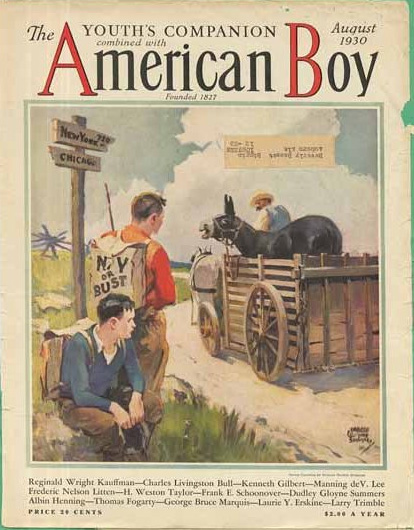
During my young years I did have a subscription to the American Boy magazine, whether my parents paid for it, or whether it came out of my allowance I’m not sure. The magazine would carry ads for Lionel and American Flyer trains, and you could write in and get their free catalogs. I did this and I spent a lot of time poring over the trains shown in these brochures. Most of them were far beyond any possibility but I recall one of the smaller sets for $13.00. I calculated that by saving my 25¢ weekly allowance for a year I could reach this goal but of course I never did. As it was, the weekly allowance was already committed in part for certain things (such as the weekly Sunday School 5¢ offering) and whatever my goal I’m sure that I could never have kept it in mind for a whole year. So I treasured the catalogs and dreamt my dreams.


American Boy
magazine, August 1930

Though I had these longings for a larger Erector set and an electric train, I can’t say that I was really envious of those of my young friends who had them, and I feel that I was happy with my lot. I recall playing at the home of one of my friends — one Clare Johnson. He had a large Erector set with the small electric motor and seeing it certainly increased my desire for such a set. In retrospect though I consider myself much more fortunate that Clare. His father was a postal mail carrier who started speculating on the Board of Trade in Fort Dodge, and managed to lose the farm they had and their home; he ended up shooting himself. Clare, his mother and his sister had to move into their grandparents’ home.